Miqat – The Boundaries Where the Pilgrimage Begins
Miqat Team
What Does Miqat Actually Mean?
Anyone learning about Hajj or Umrah will sooner or later encounter the term Miqat. But it represents much more than a geographical point on the way to Mecca.
The Arabic word Miqat refers to an appointed time or place. In the context of pilgrimage, there are therefore both temporal and geographical Miqats. For most pilgrims, the geographical Miqat is particularly important: a defined boundary that a person intending to perform Hajj or Umrah should not cross without first entering the state of Ihram.
For those travelling for Hajj 2027 or the Winter Umrah 2026/2027, understanding this boundary is therefore an important part of preparing for the pilgrimage.
A Boundary Between Everyday Life and Pilgrimage
The Miqat is not simply a checkpoint. It marks a conscious transition.
Until that moment, a traveller is making their way towards Mecca. Upon entering the state of Ihram, however, something changes: the Niyyah is made, the Talbiyah is recited, and the pilgrim consciously turns their attention towards the worship ahead.
This is where the deeper symbolism of the Miqat becomes visible. Ordinary travel is left behind, and a boundary is crossed where the traveller becomes a pilgrim.
Anyone preparing for Hajj 2027 or planning a Winter Umrah 2026/2027 can therefore view the Miqat as more than a practical rule. It can also become a moment of reflection: Why am I here? With what intention am I beginning this journey?
The Five Geographical Miqats
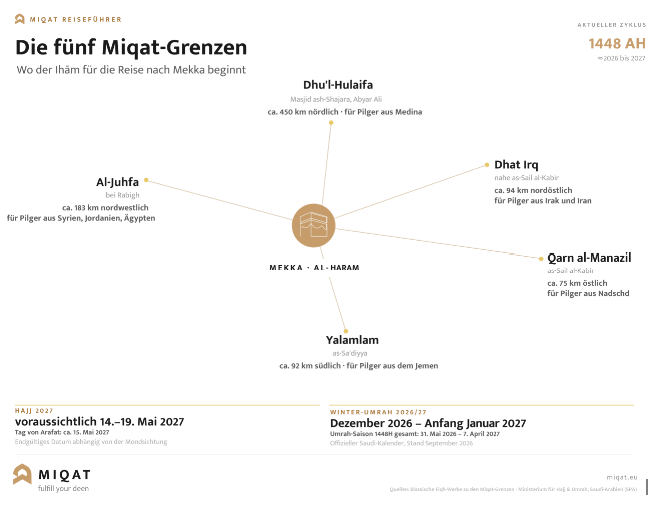
The Prophet Muhammad ﷺ designated specific places as Miqats for the different routes leading towards Makkah. Among the well-known geographical Miqats are:
- Dhul-Hulayfah for those travelling through Medina
- Al-Juhfah for travellers coming from the direction of Sham
- Qarn al-Manazil for those coming from Najd
- Yalamlam for travellers arriving from the direction of Yemen
- Dhat Irq for those coming from the direction of Iraq
What matters is not simply a pilgrim's nationality, but which Miqat or corresponding boundary their route towards Makkah crosses.
Miqat and Ihram – An Important Difference
A common misconception is that Ihram refers only to the two white garments worn by male pilgrims. In reality, Ihram describes the special ritual state that a pilgrim enters with the appropriate intention.
The garments may therefore be put on before reaching the Miqat. What matters is that a person intending Hajj or Umrah does not pass the Miqat without having entered Ihram.
For someone preparing for Hajj 2027 or the Winter Umrah 2026/2027, understanding this distinction is part of good preparation. The moment of Miqat should not come as a surprise but be experienced consciously.
Miqat and the Haram Boundary Are Not the Same
The Miqat is not simply the city boundary of Mecca, nor is it the same as the boundary of the Haram.
The geographical Miqats lie farther outside Mecca and define the point at which pilgrims arriving from outside enter the state of Ihram. The Haram boundary, on the other hand, marks the specially protected sacred area surrounding Makkah, where additional rules apply.
The Miqat therefore acts as a threshold to the pilgrimage – long before the Kaaba comes into view.
Why a Boundary Can Have Spiritual Meaning
We often think of boundaries as restrictions. The Miqat can represent the opposite. The boundary creates clarity. From this moment onwards, the pilgrim's attitude changes. Certain actions are consciously avoided, the Talbiyah accompanies the journey, and the destination draws closer not only geographically but inwardly as well.
Pilgrims arrive with different backgrounds, professions, languages and personal stories. Yet on the way towards the Kaaba, many of these differences begin to fade. The Miqat reminds us that the journey towards Allah begins consciously.
The Name Miqat – And the Idea Behind It
For us, the name Miqat therefore carries a special meaning. It represents a clear starting point: the moment when an intention becomes a real journey. Pilgrimage does not begin only with Tawaf. It begins with knowledge, Niyyah and preparation – and the Miqat makes this transition visible.
Those considering Hajj 2027 or wishing to travel for the Winter Umrah 2026/2027 encounter at this boundary one of the first significant moments of pilgrimage: the conscious step from ordinary life into the state of Ihram.
Hadith
“These places are for them and for whoever passes by them intending Hajj or Umrah.” (Narrated from Ibn Abbas by Al-Bukhari and Muslim)
Explanation: This hadith shows that the Miqats were deliberately established as starting points for pilgrims. They remind us that pilgrimage begins not only with movement towards Mecca, but with clear intention and conscious preparation.
Perhaps your own Miqat is closer than you think – the moment when an intention becomes a journey.
Fragen zu deiner Reise? Wir nehmen uns Zeit dafür.
Des questions sur votre voyage ? Nous prenons le temps d’y répondre.
Questions about your journey? We take the time to answer them.
Kontakt aufnehmen Nous contacter Get in touch